Warning: May contain Spider-man: Far From Home spoilers.
C.S. Lewis once stated, that man’s original sin was not sex. It was the attempt to entertain the idea that we could be God. Eventually, it doesn’t matter what manner of paradise we are placed in. If what the heart gleans from that, is that we can be untethered from the limits placed on us by God’s moral law, then we are fighting to sit on the Throne. And since God will not share his throne, we are doomed to the abyss. This is the story of Lucifer’s rebellion. It is the story of Eden. It is the story of the tower of Babel. And on, and on, it goes. All the way into the MCU, and Spider-man: No Way Home.
To catch up a bit: In defeat, Quentin Beck/Mysterio (Jake Gyllenhaal) has suffered a mortal wound by his own hand. With his dying breath, he reveals Peter Parker’s identity as Spiderman, while framing our hero as his murderer.
Parker, with his real identity now in the open, sees his life in all the chaos that every superhero fears. All the clever tricks are gone, along with the mild-mannered sanctuary his alter-ego provided. For the first time in the MCU, the revelation of a secret identity is finally acknowledged as a burden. That burden is especially heavy for Parker, who still maintained some connection to the real world, outside of the superhero business.
The toll this takes on Parker’s emotional stability is only intensified, by the toll it takes on those closest to him. Despite his best efforts, it is clear they will pay heavily for their involvement with him. Helpless against this insurmountable fallout, he seeks out Dr. Strange.
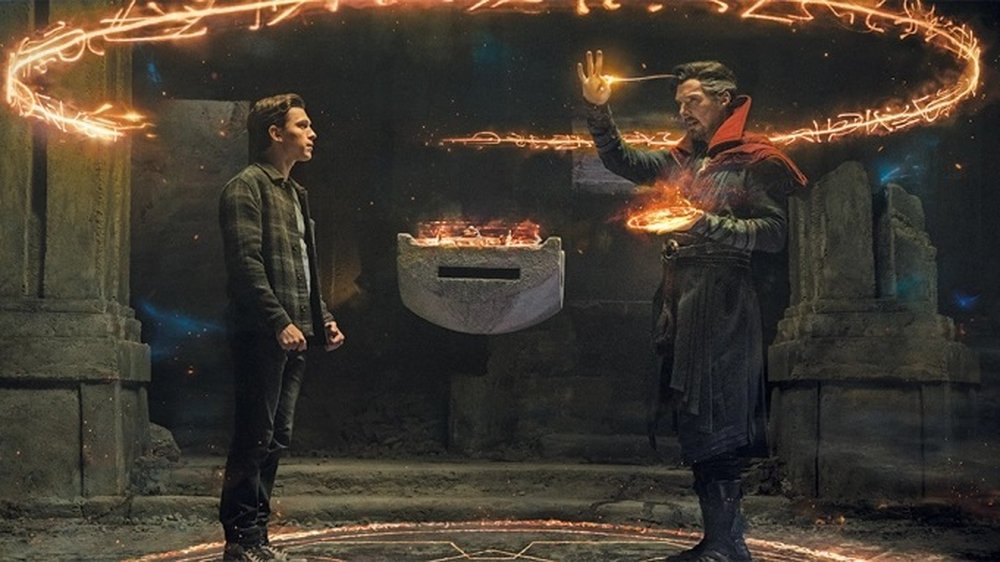
After some (arguably feeble) attempt at pushback, Strange indulges the request to cast a spell that would wipe the world’s memory of Parker as Spiderman. This progresses well enough, until tired of Parker interrupting with caveats, Strange stops the spell, and shows him the door.
The damage is already done however, as this has triggered a break in the divide between our universe and unknown ones. That is, they are unknown, until Dr. Octopus, and other recognizable villains show up. Each on the hunt for their own respective Spiderman, mistake Holland’s Spiderman for their own.
This is not strictly speaking, a film review, so what is good and bad on the technical side of things, will have to be laid aside. This is an observation into the central premise of the story. In this regard, this is an observation into what is wrong with this film (and previous installments of the MCU in general). There is an idea that seems to pervade Marvel, and whether by design, or by accident, it is seriously misguided.
Dr. Strange’s response to the previously mentioned problem, is the obvious solution. Send these villains back to the universe in which they came from, and meet whatever fate belongs to them. Parker, clearly adamant to maintain the lofty naivete of a child, refuses. He deduces that these men are bad because of some defect or another within their system, and that by “fixing” this defect, he can save them. If he saves them, they may not have to die.
In an extended struggle that spans from the physical realm to the mirror dimension, Spiderman manages to overpower Dr. Strange, leaving him trapped, as he proceeds to his new fangled idea. In doing so, you see the story affirm some of the worst human instincts imaginable, to achieve the shallowest satisfaction considering the cost.
It is understandable that a hero begins his journey with some level of hubris. It actually works as a setup to a discovery that his greatest war is perhaps, with himself. What we get here unfortunately, is a team of storytellers, who have no idea what is even good, or bad about the premise they throw on screen.
In reality, men are not machines. They do not become evil because of some bad wiring, or wrong circuitry. And to whatever extent their nature can be sourced, the remedy is never some externality, like some potion, or some brilliant math whiz kid in a spandex. All the wars for a man’s soul are waged within his heart. Not in his brain. And so if there is to be salvation, it must be within. Nothing breaks that law. Not even a banging new compromise deal between Marvel and Sony.
As Dr. Strange is dispatched, so is apparently, the only source of reason in the film. Peter is now left to continue the rest of the story, surrounded by people singularly programmed to affirm his own childish stupidity.
Aunt May, who has now broken up with Happy Hogan (a development that contributed absolutely nothing to the story), won’t shut up with the nauseating cliches about the goodness of Peter’s heart. Happy was of course, the other correctional figure in Parker’s life. This time, he’s reduced to a forlorn ex-lover, pining after May, and otherwise, useless. The rest of Parker’s companions are not much better. Compliant, and enabling, they soldier along, with barely a debate among them as to the abject foolishness of what is about to happen.
This follows a now familiar pattern that now embodies the ethos of the MCU. The protagonist is good, and so whatever atrocious actions they take, is justified. Why? Well, they have a good heart, and that’s that. Most of the time, the reason this atrocity is committed, has little to nothing to do with a larger purpose. They are often done for staggeringly petty, and trivial reasons. The question of the cost everyone else has to pay for their misguided actions, is moot. How unjust their actions are on the innocent, is barely ever even acknowledged, let alone confronted. In this kind of atmosphere, the “hero” takes the place of God. and he only needs to walk in whatever he finds “right in his own eyes.”
For the mindless fan base, fine. For the objective observer of the film’s ability to achieve what a story is meant to achieve, you’re left repeatedly going “yikes!” Is there no one else who can talk some sense into this boy? As Aunt May utters the famous “with great power comes great responsibility” line, you wonder why she herself, didn’t learn that lesson. You also wonder why this somehow fails to apply to the villains who Parker now thinks aren’t responsible for their own nature. It is particularly disheartening, because this line encapsulates the motif behind the Spiderman ethos more than anything else.
Spiderman, is arguable the greatest hero ever created by Marvel. A lot of the younger generation may be surprised to learn this. He is certainly the most recognizable in the mainstream. Whatever you think of Tony Stark, or Steve Rogers, audiences had to look them up when their respective films were coming out. At that time, the name Peter Parker was already a household name. Even before Sam Raimi made his name explode. This is extremely important, because in the comic book genre that contains the likes of Superman, Batman, and Thor, Spiderman’s power’s are paltry by comparison. So it’s easy to miss why this is true. But it is true, nonetheless.
Spiderman’s unique draw, was the same thing that made Simon Peter the most prominent disciple among the twelve. In both cases, the two Peters are inadequate to begin with. Not just in strength, but sometimes in wisdom. They then eventually gain this power, but find out in their own way, the danger of it’s excess (understanding this, is why Sam Raimi’s Spiderman 2, is still the greatest Spiderman movie ever made). Most importantly, they are the characters in their respective stories, who are most like us. So we understand him. We are after all, imperfect, as he is imperfect. And so if he be good while imperfect, we can strive for goodness, even as we are faced with imperfections of our own.
It is crucial that to whatever extent the story of Parker matters to us, it must still live in that moral universe. That our imperfections separate us from the ideal. That whatever consequences come by those imperfections, must humble us. They should never be ignored in our zeal to reinforce our own special goodness. When we have sinned, we have fallen short. Our sins are not somehow just another component of our so-called inherent goodness. This is hubris, and our desire to achieve this hubris, gives way to original sin. Whatever comfort we gain from it, it is still the fastest exit out of paradise.
Discover more from The City Gate
Subscribe to get the latest posts sent to your email.

 The City Gate